CHOOSE LANGUAGE:
 /
/
 /
/
 /
/

/
/
/
/
/
/

code: 850.TCE.065.RAC
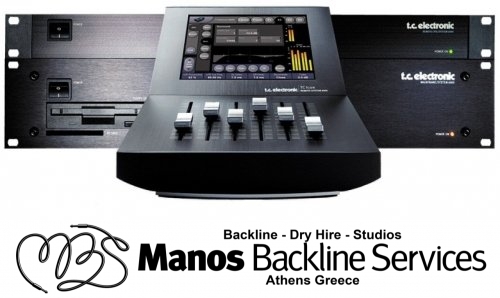
Ultimate reverb and processing for any format
System 6000 is an industry milestone. It is a proven fact that processors have made a genuine leap forward during the past 10 years. System 6000 was honored with the prestigious TEC award in year 2000, but its software and processing capabilities have developed immensely since then. This development path offers System 6000 users a wealth of free additions and new license possibilities.
A System 6000 without additional licenses, AKA Reverb 6000, contains dozens of pristine reverb, delay and boundary effects for any format from mono, stereo, LCR, LtRt to 5.1 and 6.1. Among the hundreds of
presets available, the Halls of Fame bank and the Skywalker Sound Collection provides presets created by some of the most respected people in the music and film industry. With internal double precision
processing, superb jitter rejection and reference quality AD and DA converters, no other reverb on the planet comes close to the resolution and performance of Reverb 6000.
Clearly, a high quality realtime processor can be used for more than spatial effects. Numerous license extensions are available in order to turn the 6000 into a mastering processor, monitor matrix, format converter and much more. Upsampled limiters, multiband processors, up- and down-conversion, George Massenburg's wonderful MDW Eqs and Pristine research-intensive processing a la carte can be used stand-alone or well integrated with large format consoles or digital workstations.
Generic Reverb
Generic reverb is primarily a flattering sustain effect which can be added to many sources of a mix, or a complete stereo or multi-channel stem. It adds little character but also does no harm, because the effect is blurred or washed out.
If early reflections are offered, there are only few of them and they play a rudimentary role. Therefore, a strong localization is not imposed on the signal, which is what you want when one reverb is used on many sources.
For a graphical artist, the equivalent tool to Generic reverb would be a paintbrush.
Generic Reverb Pros
| TC Icon | |
| Display Type | 6,5"TFT active matrix color LCD display,640 x 480 pixels resolution. High luminance (300 cd/m2,typ.) |
| Touch Screen | Resistive,20 gram activation force |
| Faders | Six (6),90mm motorized with touch sensitivity |
| Connection | 36-pin MDR connection for Remote CPU 6000 |
| EMC Complies with | EN 55103-1 and EN 55103-2, FCC part 15 class B, CISPR 22 class B |
| Safety Certified to | IEC 60065,EN 60065,UL 6500 and CSA E65 |
| Environment Operating Temperature | 32 °F to 122 °F (0 °C to 50 °C) |
| Storage Temperature | -22 °F to 167 °F (-30 °C to 70 °C) |
| Humidity | Max.90% non-condensing |
| General Finish | Black anodized aluminum, Stand plate in brushed stainless steel |
| Dimensions | D:279mm W:198mm Hfront:33mm Hback:100mm |
| Weigh | t 5,56 Ib (2,51 kg) |
| Mainframe 6000 | |
| Digital Inputs and Outputs | |
| Connectors | D-SUB,25 pole (8 channels AES/EBU in/out) |
| Formats | AES/EBU (24 bit) |
| Word clock input | BNC,75 Ohm or Hi-Z,0.6 to 10 Vpp |
| Internal sample rate | 96 kHz,88.2 kHz,48.0 kHz,44.1 kHz |
| Internal Clock Precision | +/-30 ppm |
| Jitterrejection at External Sample Rates | 30 to 34 kHz,42.5 to 45.5 kHz,46.5 to 48.5 kHz, 85 to 91 kHz and 93 to 97 kHz. |
| Rejection Filter (4'th order) | < -3 dB @ 50 Hz < -65 dB @ 500 Hz < -100 dB @ 1.4 kHz |
| Rejection Filter Peak (jitter gain) | < 1 dB @ 2 Hz |
| Intrinsic Interface Jitter | < 1 ns peak, BW: 700 Hz to 100 kHz |
| Digital Output Phase | < 3 % of sample period |
| Input variation before Sample Slip | +27% / -73% of sample period |
| Output Dither | HPF/TPDF dither 8-24 bit, mono |
| Processing Delay | 0.15 ms +0.21 ms per engine @48 kHz, 0.07 ms +0.1 ms per engine @96 kHz |
| Frequency Response DIO | DC to 23,9 kHz +-0,01 dB @48 kHz, DC to 47.9 kHz +-0.01 dB @96 kHz |
| PCMCIA Interface Connector | PC Card,68 pin type 1 cards |
| Standards | PCMCIA 2.0,JEIDA 4.0 |
| Card Format | Supports up to 2 MB SRAM |
| Floppydrive | DOS compatible,3 1/2",1.44 Mb |
| Control Interface MIDI | In/Out/Thru:5 Pin DIN |
| GPI,Pedal,Fader | phone jack,0 ohm to 50 kohm |
| Remote | Custom MIDI In & Out |
| SMPTE | Input for Cuelist Management |
| Ethernet | 10/100 Mbits/s,Base-T |
| EMC Complies with | EN 55103-1 and EN 55103-2, FCC part 15 class B, CISPR 22 class B |
| Safety Certified to | IEC 60065,EN 60065,UL 6500 and CSA E65 |
| Environment Operating Temperature | 32 °F to 122 °F (0 °C to 50 °C) |
| Humidity | Max.90 %non-condensing |
| General Finish | Black anodized aluminum face plate, Painted and plated steel chassis |
| Dimensions | 3 1/2 x 19 x 12 inches |
| Weight | 19 lbs.(8.6 kg) |
| Mains Voltage | 100 to 240 VAC,50 to 60 Hz (auto-select) |
| Power Consumption | 45 watts |
| Backup Battery Life | >10 years |
| ADA 24/96 Analog input | |
| Connectors | XLR balanced (pin 2+, pin 3-) |
| Impedance | 10/3 kohm (Balanced/unbalanced) |
| Selectable Full Scale Input level | 6, 12, 18, 24, 30 dBu |
| Dynamic Range (A-In: 12, 18, 24, 30 dBu) | > 113 dB (unweighted), BW: 20-20kHz |
| THD-N | < 105 dB @ 1kHz, -3 dBFS |
| Frequency Response (*with linear filter) | Output Sample Rate @ 32 kHz @44.1* kHz @ 48* kHz @ 96* kHz |
| +0/-0.1 dB +0/-3 dB |
1.2 Hz - 14.8 kHz |
| Crosstalk | < 120 dB, 20 Hz - 20 kHz |
| CMRR (A-in: 24 dBu, Rs: 2x20 Ohm) | > 80 dB @ 50/60 Hz & > 90 dB @ 1 kHz 24 bit (Dual bit delta sigma sampling at 4.1/5.6/6.1/6.1 mHz) |
| ADA 24/96 Analog Output | |
| Connectors | XLR balanced (pin 2+, pin 3-) |
| Impedance | 40/20 ohm (Balanced/unbalanced) |
| Impedance Balance | > 60 dB, @ 20-20 kHz |
| Signal Balance | > 40 dB, @ 20-20 kHz |
| Selectable Full Scale Output Level | 6, 12, 18, 24, 30 dBu (Balanced/unbalanced) |
| Dynamic Range (A-Out: 18, 24 dBu) | >113 dB (unweighted), BW 20-20kHz |
| THD+N | > -95 dB @ 1 kHz, -3 dBFS |
| Frequency Response (*with linear filter) | Output Sample Rate: |
| Crosstalk | < 110 dB, 20 Hz - 20 kHz |
| In/Out Sample Rate 32/96 | Fixed filter |
| In/Out Sample Rate 44.1/48 | Filter choices: Linear, Natural, Vintage, Bright & Standard |
| Remote CPU 6000 | |
| CPU | Embedded Cyrix GXM-200 processor |
| System Disc | 32MB CompactFlash Card |
| System Memory | 32MB SODIMM Ram |
| Operating System | Windows NT embedded version 1.0 |
| Connections | 10/100 Mbits/s,Base-T,IEEE 802,3 pico protocol compatible. RJ-45 connector |
| USB Interface | Two Universal Serial Bus ports,USB 1.0 compliant |
| Keyboard/Mouse | Mini-DIN connector supports standard PC/AT keyboard and a PS/2 mouse. |
| Remote | 36-pin connection for TC Icon |
| EMC Complies with | EN 55103-1 and EN 55103-2, FCC part 15 class B, CISPR 22 class B |
| General Finish | Black anodized aluminum face plate, Painted and plated steel chassis |
| Dimensions | 1,75"x 19"x 8,2"inches (483 x 44 x 195 mm) |
| Weight | 4,7 Ib.(2,13 kg) |
| Mains Voltage | 100 to 240 VAC,50 to 60 Hz (auto-select) |
| Power Consumption | 50 watts |
| Backup Battery Life | >10 years |
| SP-1 Joystick Controller | |
| Front panel dimensions | 125 x 84 mm 4.9" x 3.3" |
| Enclosure dimensions | 20 x 65 x 35 mm 4.7" x 2.6" x 1.3" |
| Weight | 350 gr |
| An AC or DC supply may be used Consumption | typ 70mA@9VAC |
| AC supply voltage | 8-12V |
| DC supply voltage | 9-12V (+ on center pin) |
| MIDI In 5 pin DIN connector | Merge and learn |
| MIDI Out 5 pin DIN connector | Pan and FX control |
| AES 8 | |
| Connectors | D-SUB, 25 pole (8 channels AES/EBU in/out) |
| Format | AES/EBU (24bit) |
| Supported sample rates | 96 kHz, 88,2 kHz, 48 kHz, 44,1 kHz, 32 kHz |
| Intrinsic interface jitter | < 1 ns peak, BW: 700Hz to 100kHz |
| Digital output phase | < 3 % of sample period |
| Input variation before sample slip | +27 % / -73 % of sample period |
| Output Dither | HPF/TPDF dither 8-24 bit |
| Processing Delay | 0.15ms + 0.21 ms per Engine @ 48kHz 0.07 ms + 0.1 ms per Engine @ 96kHz |
| Frequency response DIO | DC to 23,9kHz +/- 0,01 dB @ 48kHz DC to 47,9kHz +/- 0,01 dB @ 96kHz |
| EMC | Black anodized aluminum Stand plate in brushed stainless steel |
| Complies with | EN 55103-1 and EN 55103-2 FCC part 15 class B |
| Safety | CISPR 22 class B |
| Certified to | IEC 60065, EN 60065, UL 6500 and CSA E6 |